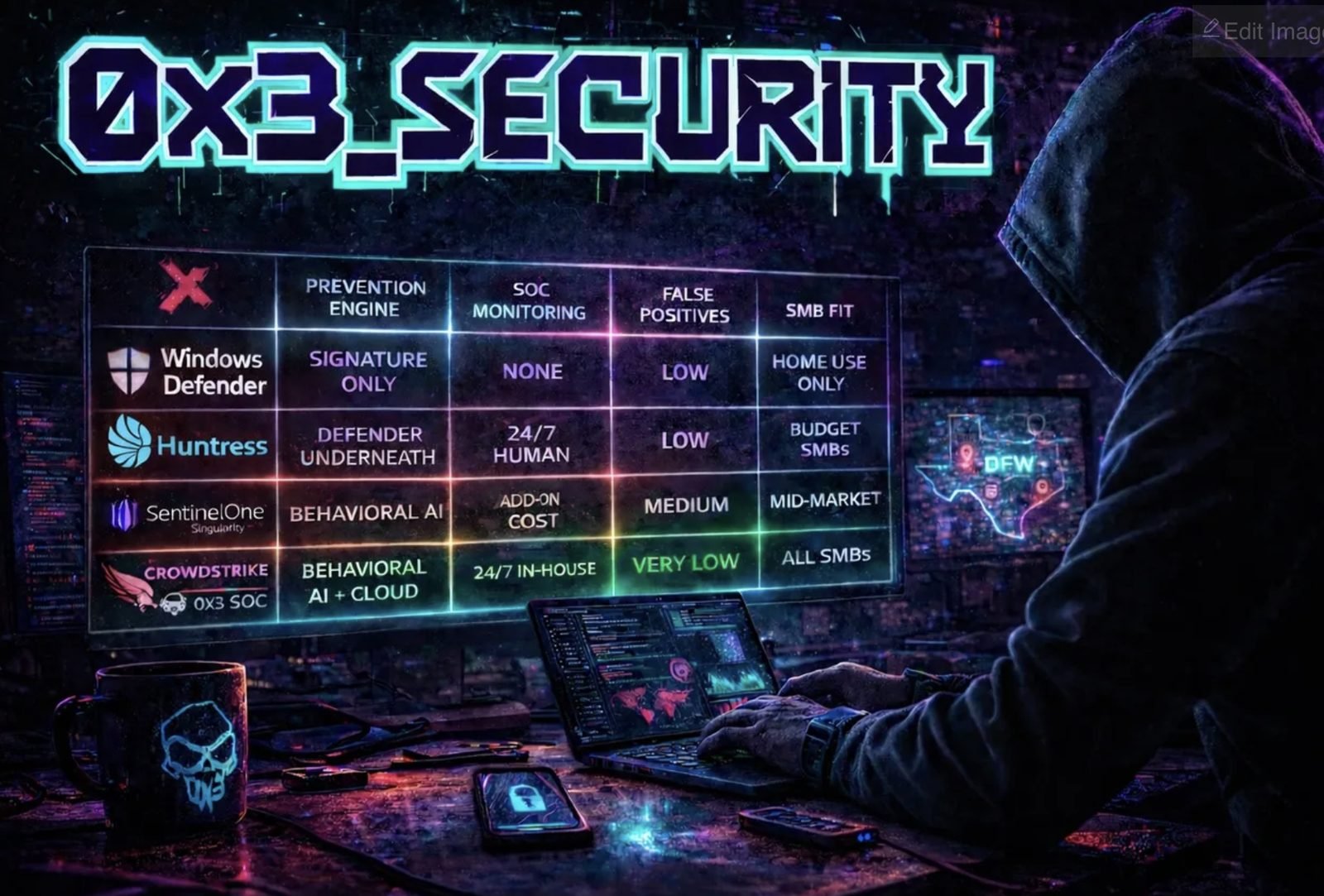
Best EDR for Small Business in 2026: A Pentester's Honest Comparison
By Paul Nieto IIIMar 10, 202610 min read
Let me settle the debate: Windows Defender vs Huntress vs SentinelOne vs CrowdStrike Falcon. I've deployed all of them, and I've also broken through networks protected by all of them. Here's the view from both sides of the wire — with the caveat that EDR products evolve fast, so treat pricing and feature specifics as a starting point, not gospel.
Microsoft Defender
Two things often get conflated here. Microsoft Defender for Endpoint is a genuine, capable EDR — a perennial Gartner Magic Quadrant leader — and even the free, built-in Defender Antivirus now includes cloud-delivered machine learning and behavioral detection, not just signatures. So "Defender is just signature AV" isn't accurate anymore.
The real point for SMBs: free, built-in Defender Antivirus alone — with no SOC, no threat hunting, and nobody watching the alerts — isn't a security program for a business with patient records or client data. The engine is solid; the missing piece is the humans and the response. Good for: a baseline you build on. Not good enough alone for: regulated industries or anyone where prevention and detection both matter.
Huntress (Managed EDR)
Huntress is solid, and worth clearing up a common myth: Huntress now ships its own purpose-built EDR agent across Windows, macOS, and Linux — it doesn't depend on Defender's engine underneath. It can optionally manage Microsoft Defender Antivirus for you at no extra cost (a nice way to save money), or run alongside other AV, but the EDR and 24/7 human-led SOC are Huntress's own. For budget-constrained SMBs that want managed detection and response without standing up a SOC, it's a legitimate, well-regarded option known for a low false-positive rate and fast MTTR.
SentinelOne Singularity
Real EDR territory. SentinelOne's AI engine is genuinely impressive — autonomous response, behavioral detection, and ransomware rollback that can kill a threat and restore encrypted files without a human in the loop. The catch for SMBs is that it's built for environments with internal security teams who can tune it; it can be noisy and needs configuration, and rollback is a safety net — ideally you want prevention, not recovery. It tends to carry a heavier endpoint footprint and higher per-endpoint cost at comparable tiers than CrowdStrike, though exact pricing varies by contract. Good for: companies with some internal IT/security capacity.
CrowdStrike Falcon + the 0x3 SOC
This is what we deploy, and here's why. Falcon is cloud-native, with a single lightweight agent that works across Windows, Mac, and Linux with no dependency on Defender or anything else — deploy it and it works. It's FedRAMP authorized and used by US federal agencies, it performs strongly across independent testing and the MITRE ATT&CK evaluations (including the Managed Services evaluation), and it generates high-fidelity alerts with low false positives at a light CPU footprint.
A note on MITRE, because every vendor claims they "won": MITRE deliberately does not rank vendors or declare winners — it publishes how each product performed against emulated adversary techniques. CrowdStrike performs strongly and has participated in the Managed Services evaluation; that's the honest framing.
And here's the part most people get wrong: the platform is the weapon; the SOC pulls the trigger. High-fidelity alerts are useless if nobody's watching them. That's where our in-house 24/7 SOC comes in — every alert, every endpoint, every anomaly, 3am on a Tuesday included. Falcon's detection plus human response is what gives DFW businesses the same protection posture as companies many times their size.
The honest comparison
Microsoft Defender — capable EDR engine; free AV alone has no SOC. Best as a managed baseline.
Huntress — own EDR agent + 24/7 human SOC; great fit for budget-constrained SMBs.
SentinelOne — strong autonomous AI EDR; best with internal staff to tune it; heavier/pricier at comparable tiers.
CrowdStrike + SOC — cloud-native, lightweight, very low false positives; what we run, paired with our 24/7 in-house SOC.
"Is CrowdStrike overkill for a small business?"
After two decades on the offensive side: no. What's overkill is paying six figures to recover from a breach a properly deployed and monitored EDR would have caught in the first 30 seconds. DFW dental offices, law firms, medical practices, and accounting firms are targeted specifically — because attackers know your data is valuable and your defenses are thin. We're here to fix that.
— Paul Nieto III, Founder, 0x3 Security (OSCP · CRTO · CRTP · CPTS · CBBH · PNPT)
Want to see what attackers see? If you're running Defender alone and want to understand your real exposure, we'll run a free external attack-surface scan.